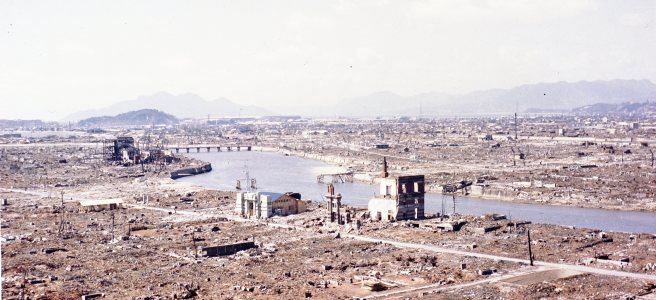
The other day I got into a discussion (debate is too strong a word) with a guy I know. Highly intelligent and very experienced in politics and public administration, he was telling me about how he had just seen the new Christopher Nolan film Oppenheimer. We talked about the movie, the acting and so forth, and then he suddenly added something to the effect that the decision to drop nuclear weapons on the Japanese cities of Hiroshima and Nagasaki in the summer of 1945 was altogether correct and necessary. His rationale hinged on the view that the impending invasion of the Japanese home islands (known in military circles at the time as Operation Downfall) would lead to unimaginable casualties among American forces.
His tone struck me as though he considered it a settled matter, which caught me off guard.
I made some feeble attempt to gently argue the point (both of us were drinking wine at the time). Yes, military planners predicted substantial casualties during Downfall, but given Japan’s thoroughly wrecked state by the summer of 1945, there is the question as to whether those casualties would have been a reality in an actual invasion.
I’m by no means an expert in the use of nuclear weapons during World War II, but I have read a good deal of scholarship on President Harry Truman’s decision-making process. I also took a class in the history of nuclear weapons at the University of California, Santa Barbara in the mid-1990s which was taught by the late Professor Lawrence Badash, a renowned expert in the field who conveyed a quiet authority on the matter that impresses me to this day.
Badash’s class haunts me to this day. It was the only college course I ever took in which I still go over some of the assigned readings (John Hersey’s book Hiroshima, General Leslie Grove’s report on the Trinity test, to name a couple). He also showed us the disturbing 1976 1965 BBC anti-war film The War Game, though he prefaced it by saying that viewing the film was entirely optional, and that he’d seen the film enough times and had no desire to watch it again. I recently attempted to watch the film again, but decided to turn it off at exactly the point I walked out back in college. Though an excellent film, it remains far too wrenching for me to watch, even to this day.
Basically, I know enough about Truman’s decision to drop the bomb to know that it’s far from a settled matter. In fact, one of the most striking things I learned in Badash’s class was that at the time of the Hiroshima and Nagasaki bombings, opinion in the highest American military circles was decidedly that the bombs played little to no role in the Japanese government’s decision to surrender to U.S. forces.
This is a very complex point, because many factors played into the surrender decision (the best book I’ve found on this is The Decision to Use the Atomic Bomb by Gar Alperovitz). But there is no shortage of sources available today to make clear that U.S. military leaders at the end of the war (and even later) felt the bombs simply weren’t necessary to ensure Japanese surrender.
Since many people are seeing Nolan’s movie now (though I have not as yet), it occurred to me that these same individuals might be unaware that the top American commanders, almost to a man, opposed nuclear strikes on Japan. Or that they weren’t shy about expressing this opposition.
To me, the most compelling argument against the use of atomic bombs came from the United States Strategic Bombing Surveys, a series of documents published right after the war on the effectiveness of American bombing campaigns during the war. Though researched and written by civilian experts, the surveys were conducted at the behest of Army Air Force Generals Hap Arnold and Carl Spaatz and carry great weight with historians today..
On the nuclear strikes against the cities of Hiroshima and Nagasaki, the survey’s conclusion was unambiguous:
Based on a detailed investigation of all the facts, and supported by the testimony of the surviving Japanese leaders involved, it is the Survey’s opinion that certainly prior to 31 December 1945, and in all probability prior to 1 November 1945, Japan would have surrendered even if the atomic bombs had not been dropped, even if Russia had not entered the war, and even if no invasion had been planned or contemplated.
This was also the consensus of opinion of the military command after the war. To get an idea, we can start with General of the Army Dwight Eisenhower, who was later elected U.S. President in 1952.
“General Eisenhower mentioned how he had hoped that the war might have ended without our having to use the atomic bomb,” U.S. Navy Lieutenant Robert Meiklejohn wrote in his diary on Oct. 4, 1945. An aide to Averell Harriman, then U.S. Ambassador to Russia, Meiklejohn had attended a meeting between his boss and Eisenhower, in which the use of the bombs had come up during discussion. Meiklejohn’s diary represents the earliest written record of Eisenhower’s concerns about the use of nuclear weapons, according to the National Security Archive.
In his later memoirs, Eisenhower expanded on these thoughts:
“I voiced to [Secretary of War Henry Stimson] my grave misgivings, first on the basis of my belief that Japan was already defeated and that dropping the bomb was completely unnecessary, and secondly because I thought that our country should avoid shocking world opinion by the use of a weapon whose employment was, I thought, no longer mandatory as a measure to save American lives. It was my belief that Japan was, at that very moment, seeking some way to surrender with a minimum loss of ‘face.’”
Years later, in a 1963 interview, Eisenhower expanded on this, saying simply that “the Japanese were ready to surrender and it wasn’t necessary to hit them with that awful thing.”
Eisenhower was far from alone in this view. Here are the thoughts of other American military leaders:
Admiral William Leahy, Chairman of the Joint Chiefs of Staff, wrote in his 1950 memoir that “the use of this barbarous weapon at Hiroshima and Nagasaki was of no material assistance in our war against Japan. The Japanese were already defeated and ready to surrender.”
Admiral William Halsey, U.S. Third Fleet Commander, said in 1946 that, “The first atomic bomb was an unnecessary experiment. It was a mistake to ever drop it. Why reveal a weapon like that to the world when it wasn’t necessary?”
General Douglas MacArthur, Supreme Commander, Southwest Pacific, said there was “no military justification for the dropping of the bomb.”
Admiral Chester Nimitiz, Pacific Fleet Commander, said the bombs “were of no material assistance in our war against Japan.”
What’s more, these statements were pretty widely known in the years immediately following the atomic bombings. In Halsey’s case, for instance, the remarks received newspaper coverage, which is where I found them while researching this post.
To be fair, after mentioning all this in class, Professor Badash cautioned us that such statements could—he emphasized could—have been attributed to “sour grapes,” the idea that such focus on atomic bombings took away from the contributions Army, Navy, and Marine forces made towards the destruction of Imperial Japan during World War II. And while that view undoubtedly had some truth to it, it doesn’t explain the uncompromising conclusion of the Strategic Bombing Survey, or Eisenhower’s insistence on repeatedly returning to issue throughout the rest of his life—even after he spent eight years as President, during which the U.S. built more than 17,000 nuclear warheads, more than were built under any other president in history.

 Anthony Pignataro
I’m inclined to agree with a November surrender anyway. However, I’m somewhat influenced by the argument that at the time of bomb use, 1500 or so Americans were dying every day conducting ongoing operations. From August to November at that rate adds up to quite a number.
My inclination is to agree with https://www.jstor.org/stable/2539100?origin=JSTOR-pdf that it was “all of the above” happening at the same time that led to the August capitulation, and that was not a moment too soon.
(Came upon this via bsky)
LikeLike