[NOTE: After discussions with a writing friend, I’ve decided to start posting some of my old MauiTime stories, which disappeared from the Internet when the alt-weekly finally closed for good in late 2023. I’m starting with this essay I wrote two days after the tragic Aug. 8, 2023 wildfire that destroyed Lahaina Town, a place I had worked in for years during the early 2000s. The final death toll from the fire would eventually top 100, and I ultimately lost two people I knew to the fire, not just the one I mention here.]
Remembering Lahaina
Originally published Aug. 10, 2023 in MauiTime (RIP)
By Anthony Pignataro
Almost exactly 20 years ago, I was sitting in my new MauiTime editor’s office on the second floor of 505 Front Street in Lahaina Town. I’d been on island for about a week, and was still finding my place. Though some of the rooms overlooked the ocean, and the Feast at Lele lūʻau below, my little office (basically a cubicle with an old French door for privacy) was entirely walled in, though it did have a little couch for visitors.
It was late afternoon, and Don Couch, then an aide to Mayor Alan Arakawa, was on that couch, talking me through Maui politics and trying to help me understand why things were done (or not done) on the island. Eventually he mentioned that he was on his way to a civic meeting at Lahaina Intermediate School, and I said I’d love to attend. Since I didn’t yet have my car, Couch offered to drive me up the hill to the meeting, though he said I’d have to walk back to town when it was done. I quickly agreed.
I don’t remember anything about the meeting, except that I left early. The sun was setting as I walked back down Lahainaluna Road into town. Even as I passed the imposing, slightly scary remnants of the old Pioneer Sugar Mill, I remember being entirely pleased with the short journey. I was hungry, and though I was still unsure of all that Lahaina Town offered, I did know the way to Hard Rock Cafe. I made my way there, and enjoyed a burger and beer at the bar as I watched tourists laugh and sit on the seawall outfront and gaze at the darkening ocean — the first of so many trips there that MauiTime publisher Tommy Russo took to calling the restaurant if he wanted to reach me.
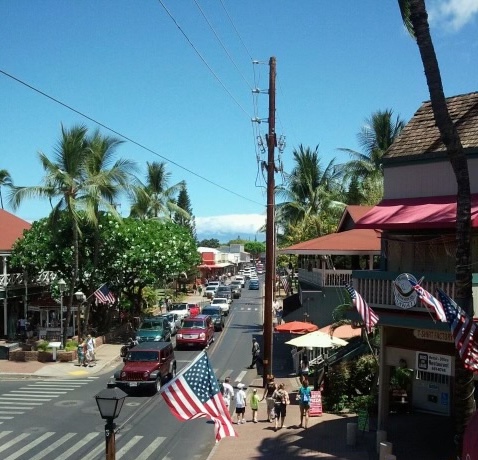
When I was done, I headed south on Front Street, passing bars, restaurants, galleries and shops that were still new to me. I passed BJ’s, later called Lahaina Pizza Co., where I’d eventually sit down with owner Jerry Kunitomo. His knowledge of Maui impressed me so much that I later put a fictionalized version of him in the three novels I wrote about Maui.
I passed the vintage European posters gallery, which I’d also write about, and the famous Banyan Tree, planted back in 1873. My friend Chris and I posed under that tree after an evening of bar hopping while he was on leave from the army. The photo of us standing there, hands clasped behind our backs and silly grins on our faces, was a cherished possession even before he took his own life in 2014.
Following the Banyan Tree, I walked by the elementary school named for King Kamehameha III, as well as Moku‘ula, his former residence. The once beautiful island home was just a ball field then, but recent years had brought serious archaeological study there.
My path then took me through the so-nice houses at Shark Pit until I was nearly at Puamana. There, in a small apartment near the highway, Tommy and his wife Jen were letting me stay with them until I found my own place.
On Tuesday night, a wildfire destroyed nearly every place I just described.
***
I lived on Maui for about a dozen years. My girlfriend Angie was there with me for about seven of those years. Our memories of the island crystalized in the spring of 2018, when we moved to Southern California. We haven’t been back since.
Since Wednesday morning, we’ve been glued to social media. Hawaii News Now’s Apple TV app runs constantly on the TV during the day — there’s very little news coming in, but seeing footage of Maui, interviews with residents and even a Guy Hagi weather report now and then alleviates some of the helplessness we feel being so far from Maui during such a staggeringly grim time.
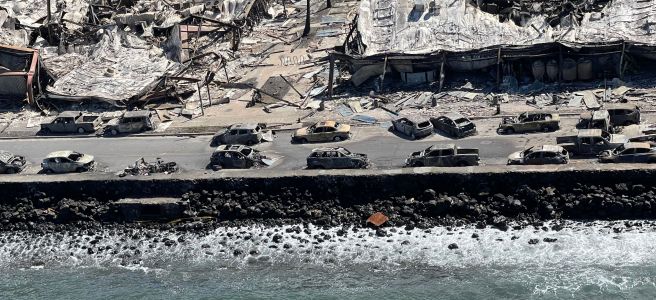
A photo appears on my Instagram feed. It looks black and white, but it’s not. It’s of a line of cars positioned haphazardly near the sea wall in front of the building that once housed Hard Rock Cafe (it later became a Tommy Bahama restaurant and retail space). The building is rubble now and the cars, which clearly had been attempting to flee the town, are completely burned.
What became of the drivers and passengers in those cars is impossible to say.
We also came across a Google doc spreadsheet of Lahaina residents who remain unaccounted for. We pour over it. It’s an exercise far too many people on Maui are doing right now.
On Wednesday, Angie and I spent all day worrying about two friends until we finally got word that they were safe later that night. Under the illusion that all was well, we slept a few hours, only to wake up Thursday morning to the startling news that nearly a half dozen other people we knew were also missing.
Thursday night, we learned that at least one of them, an elderly man, has died.
He was one of the gentlest people I met on Maui, a man who grew up in Lāhainā and is well-known there. But on Wednesday and Thursday, his family began posting a series of messages on Facebook, first anxious and then desperate, asking anyone for information as to his whereabouts.
Aerial photos showed that his house in Shark Pit, gorgeous without being ostentatious, was burned to the ground, as was his truck.
So far, there are 53 confirmed dead from Lahaina, as acknowledged by the County of Maui. Identifying the dead could take weeks — a friend who went through the Tubbs Fire in Northern California back in 2017 said it took a month to get an accurate body count.
It’s understandable that progress is slow, given the scale of destruction in Lāhainā Town. But it’s hard to reconcile 53 dead with the statements Lahaina resident Kekoa Lansford gave to Hawaii News Now on Wednesday:
“We still got dead bodies in the water, floating, and on the sea wall,” Lansford told HNN reporter Chelsea Davis in an Aug. 9 news report. “They’ve been sitting there since last night. We’ve been pulling people out since last night, trying to save people’s lives. And I feel we’re not getting the help we need, you know. Oh my god. This is a nationwide issue at this point, yeah. We need help, a lot of help. We gotta get a lot of people down here.”
“I saw the bodies as well,” Davis said quietly in her report.
***
I wish I knew what happens to Lahaina now. Paradise, California, a town of 26,000 that was completely destroyed in the 2018 Camp Fire, is still being rebuilt. Current population figures show just a fraction of that with about 6,500 residents still calling the town home.
“Rebuilding” seems like such an inadequate word when considering Lahaina, given the death toll and the fact that the town’s greatest historical and cultural structures are gone. Lahaina Town was home to the old courthouse, the Baldwin Home, the Masters Reading Room, Hale Aloha, the Wo Hing temple, the Plantation Museum and many others. Their loss is incalculable.
“What is destroyed cannot be recovered,” Sydney Iaukea (a Hawaiian history researcher and professor who also once won the Miss Lahaina pageant title) dryly noted in her 2014 book The Battle of Keka‘a, about the development of North Beach. Such losses are a very old and all-too-common story in Hawaiian history, as is astonishing death, which pretty much dominates post-contact Hawaii.
Of course, not everything in Lahaina was historical, as Iaukea has noted. Lahaina’s status as a “whaling town,” much beloved by tourists, was nonsense used to cover the town’s true Hawaiian Kingdom history.
“Lahaina was built and preserved to mimic a whaling town so that tourists vacationing at the newly built Ka‘anapali Beach Resort could visit after long days of rest and relaxation,” Iaukea wrote in a 2016 essay titled “The Re-Storing of Lahaina.” “However, the whaling tale that was recreated had very little in common with the actual industry that existed a century and a half prior. As this whaling historical record was foregrounded, all other social narratives of Lahaina took a backseat, with the missionary influence vying for a close second.”
The immediate loss of Lahaina as a tourist attraction will unquestionably hurt Maui, given the county’s stubborn desire to rely on tourism for economic growth. The damage won’t be as bad as the COVID-19 pandemic, which basically shut down all of tourism in the county for a year, but it will be bad — especially when many people and businesses are still trying to recover from challenges faced during the pandemic.
What comes next for Lahaina will be new. Lahaina will never be as it was on Monday, nor will Maui. Losses like these amount to generational trauma, which could last decades or longer. What Lahaina becomes, and whether it once again reflects the “tourist gaze,” as Iaukea has noted, will be up to residents.
But before any of that happens, Lahaina needs to account for all its residents. That will take time and inflict much pain, which I fear has only just begun.

 Anthony Pignataro
Just as lovely and heartbreaking the second time as it was the first.
LikeLike